
CSTC Loop Explained: Understanding the Brain Behind OCD
OCD can feel like being stuck in a mental loop you didn’t choose—and can’t easily exit. There’s a real reason for that. It involves a brain circuit called the cortico-striatal-thalamo-cortical (CSTC) loop.
How do we know this? Much of what we understand comes from neuroimaging research, especially fMRI (functional MRI), which shows how active different brain regions are and how they communicate. Across many studies, people with OCD tend to show increased activity and connectivity within CSTC circuits—particularly when symptoms are triggered. We also see changes in this circuit after effective treatments, which strengthens the case that this loop is directly involved (Stein et al., 2019; van den Heuvel et al., 2016).
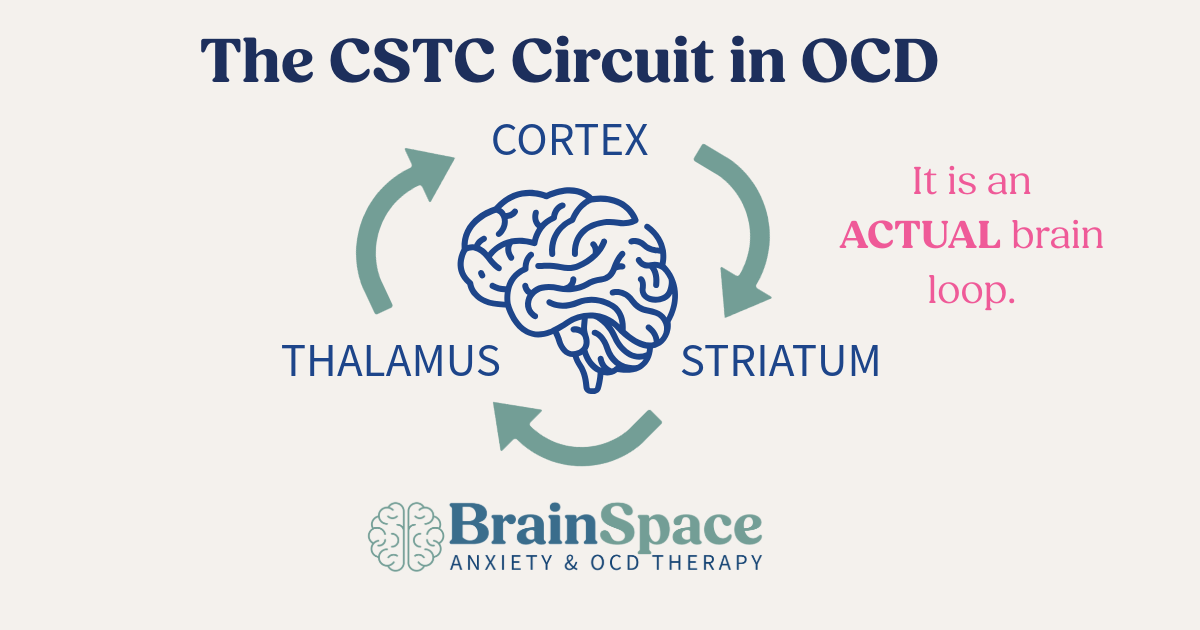
Here’s how the CSTC loop works:
The cortex (especially the orbitofrontal cortex and anterior cingulate) helps detect potential problems or “errors.” In OCD, this system can be overactive—sending repeated “something’s wrong” signals, even when you’re safe.
The striatum helps filter and prioritize information—deciding what deserves attention. In OCD, this filtering process is less efficient, so intrusive thoughts are more likely to stick rather than pass.
The thalamus acts as a relay station, sending signals back to the cortex. When the loop is overactive, it keeps reinforcing the alert—like a notification that won’t turn off.
The result? The brain cycles the same message: something is wrong, pay attention, do something. That’s the “loop” so many people with OCD describe.
If this feels familiar, you’re not alone—and you’re not broken. Your brain is trying to protect you, even if the system is overfiring.
The hopeful part: this loop can change. Treatments like Exposure and Response Prevention (ERP) help retrain the brain to tolerate uncertainty and resist responding to every alarm. Over time, the loop can quiet—and that “stuck” feeling can begin to ease.
If you’d like to experience less distress from OCD (and more BrainSpace), you’ve come to the right place. Get started here!
Sources
Stein, D. J., et al. (2019). Obsessive–compulsive disorder. Nature Reviews Disease Primers.
van den Heuvel, O. A., et al. (2016). Brain circuitry of compulsivity. European Neuropsychopharmacology.
Pauls, D. L., et al. (2014). Obsessive–compulsive disorder: An integrative genetic and neurobiological perspective. Nature Reviews Neuroscience.
Abramovitch, A., Abramowitz, J. S., & Mittelman, A. (2015). The neuropsychology of adult OCD. Neuroscience & Biobehavioral Reviews.
