
Harm OCD, Suicidal Ideation, and the Search for Certainty
When intrusive thoughts involve suicide or self-harm, OCD can demand an impossible answer: “But how do I know what I really want?” Learn why clinical assessment matters—and why certainty isn’t the goal.
Emetophobia: When the Fear of Vomiting Takes Over
Most people dislike vomiting. But for someone with emetophobia—a persistent and excessive fear of vomiting—the possibility of getting sick can begin to shape everyday life.
And if you have emetophobia, you’re far from alone. Research suggests that approximately 0.1–0.2% of people may meet criteria for a specific phobia of vomiting, while less severe but still significant fears of vomiting may affect several percent of the population. Some studies have found rates as high as 8%, depending on how emetophobia is defined and measured. Many people with emetophobia are surprised to learn that others experience the same fears.
Autism & OCD: Treating OCD While Supporting Neurodiversity
If you or someone you love has been diagnosed with autism, OCD, or both, you may wonder: "How do I know what's autism and what's OCD?"
It's an important question because autism and obsessive-compulsive disorder (OCD) often occur together. Research suggests that 17–37% of autistic individuals also meet criteria for OCD (van Steensel et al., 2011; Russell et al., 2020). Because the two conditions can look similar, understanding why a behavior is happening is just as important as the behavior itself.

“What If I Make the Wrong Choice?” How OCD Hijacks Decision-Making
For people with Obsessive-Compulsive Disorder (OCD), decision-making can feel overwhelming. A simple choice—what to wear, whether to send a text or which cereal to buy—can become an exhausting cycle of doubt, anxiety, and overthinking.
OCD often hijacks decision-making by convincing you that you need complete certainty before moving forward.
Perfectionism in Anxiety and OCD: When Good Enough Is Never Enough
Perfectionism often gets a positive reputation. People with perfectionistic traits are frequently seen as hardworking, responsible, detail-oriented, and highly driven. These qualities can absolutely be strengths in school, work, and relationships. In many ways, perfectionism can feel like a gift.
But in anxiety disorders and OCD, perfectionism can also become a trap.
Sensorimotor OCD: What To Do When You Can’t Stop Noticing
Hyperawareness, or sensorimotor OCD, involves becoming excessively aware of normally automatic sensations or processes. Instead of fading into the background, these experiences become difficult to ignore.

7 Sneaky Signs of OCD in Kids
Obsessive-Compulsive Disorder (OCD) in kids doesn’t always look the way people expect. It’s not just frequent handwashing or lining things up. In fact, many signs are easy to miss—or mistaken for personality quirks, anxiety, or even defiance.
Here, we describe some sneaky ways OCD can show up in children.

Why Traditional Therapy Can Actually Make OCD Worse
Traditional talk therapy can be helpful—but for OCD, it can sometimes make things worse. This blog post discusses five reasons why this can be the case.
Why Panic Disorder Is Highly Treatable
Panic disorder can feel unpredictable and overwhelming—but it’s also highly treatable. One reason why? Interoceptive exposure.
Panic attacks are fueled not just by physical sensations (like a racing heart or dizziness), but by how those sensations are interpreted. Many people with panic disorder become sensitized to normal bodily changes and begin to fear them—creating a loop where fear amplifies the sensations, and the sensations amplify the fear.
Interoceptive exposure breaks that cycle.
The New Reassurance Trap: How ChatGPT Is Fueling Anxiety
More and more people are turning to AI tools like ChatGPT to answer anxious “what if” questions: What if I made a mistake? What if I’m sick? What if something bad happens? On the surface, it makes sense. You get fast, thoughtful, seemingly reliable answers. Relief is just a few keystrokes away.
But for people struggling with OCD or anxiety, this can quietly become part of the problem.
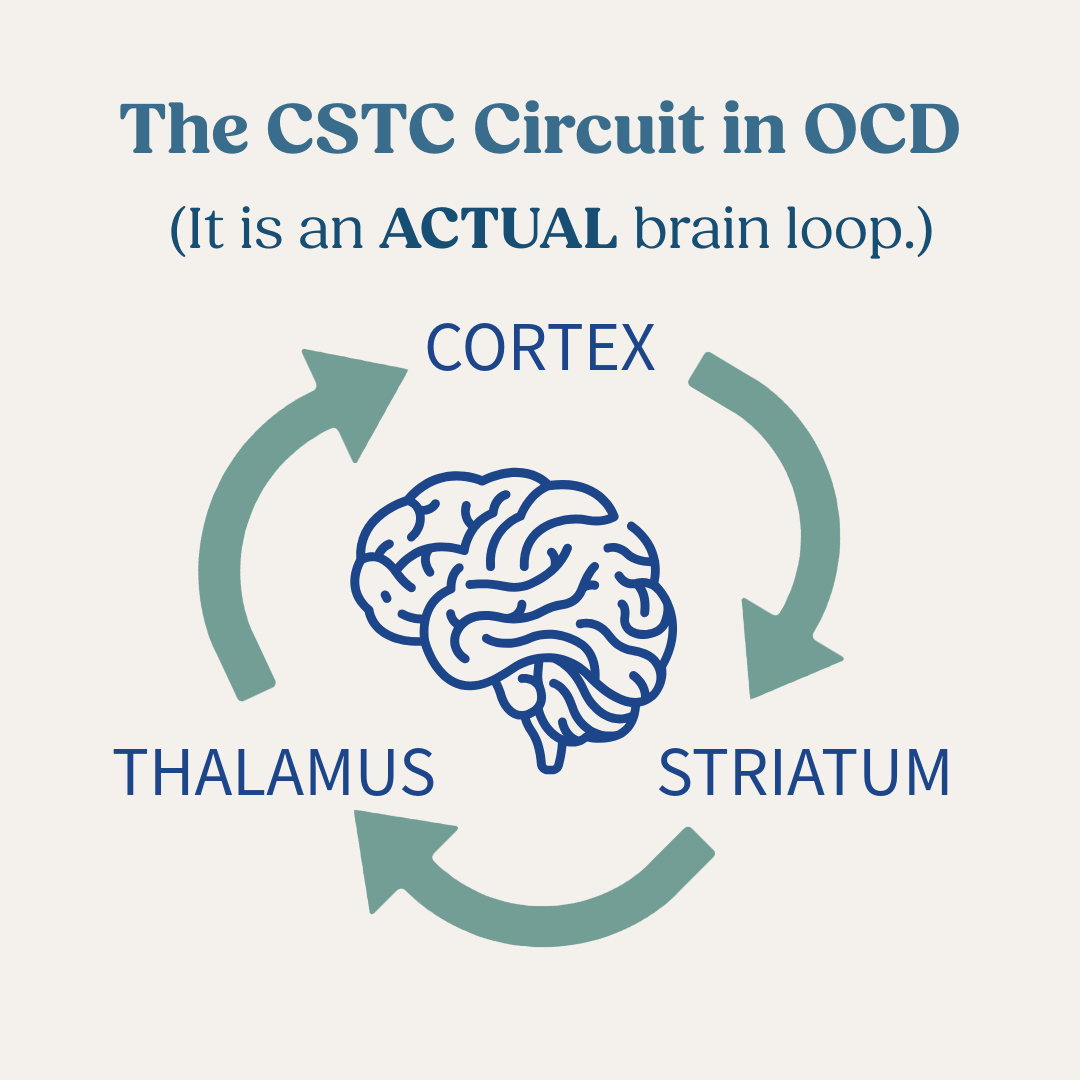
CSTC Loop Explained: Understanding the Brain Behind OCD
OCD can feel like being stuck in a mental loop you didn’t choose—and can’t easily exit. There’s a real reason for that. It involves a brain circuit called the cortico-striatal-thalamo-cortical (CSTC) loop.
When Helping Hurts: Why Removing Discomfort Keeps Anxious Kids Stuck
When we see our child struggling with anxiety or OCD, it’s only natural to want to help in whatever way will decrease their discomfort.
And in the moment? It works. Your child feels better—and honestly, so do you.
So what’s the problem?
Over time, these patterns—known as family accommodation** in anxiety and OCD treatment—actually reinforce anxiety. By removing your child’s discomfort, you unintentionally strengthen the belief that the situation really was dangerous… and that they couldn’t have handled it on their own.
The Rebound Effect: Why You Can’t Stop Intrusive Thoughts—and What to Do Instead
Many people assume that the best way to deal with an uncomfortable thought is to attempt to get rid of it as quickly as possible. If a disturbing or unwanted thought pops into your mind, the natural response is often: “I need to stop thinking about that.”
Unfortunately, our brains don’t work that way.
In fact, trying to force a thought away will typically have the opposite effect. The harder you try to suppress it, the more persistent it becomes. Psychologists refer to this as the rebound effect.